Montreal's Diaspora Creative Scene Is Having Its Moment: Here's Who's Shaping It
A lot has been built in Montreal without much fanfare. Not a trend, not a scene with a name yet. More like a generation of artists, designers, and musicians from Haitian, Caribbean, and broader diaspora backgrounds who grew up here and are now making work that's starting to get noticed beyond this city's borders.
It didn't happen because of a single institution. It happened because people kept going when the money wasn't there, found each other across disciplines, and built what they needed when the existing infrastructure didn't have room for them. This piece puts a few names to that work. It's not a complete list. That list is much longer.
Richardson Zéphir
Richardson Zéphir paints figures. The work is formally rigorous, grounded in Black figurative traditions, and made in Montreal, a combination that's less common here than it should be. His canvases have a consistency of vision that's hard to miss: you see one and you know exactly who made it. The Haitian-Canadian background isn't decoration in the work; it's in how figures are lit, how space is composed, what the paintings seem to be after.
His work has been shown locally and is accumulating critical attention at a rate that tends to compound. He's at the point in a career where the trajectory is clear even if the wider recognition hasn't fully arrived yet.
Josh Doiron
Josh Doiron is a producer and sound designer who's been part of Montreal's independent music infrastructure in ways that don't always show up in press coverage. These are the kinds of contributions other artists recognize before critics do. His sound is difficult to place cleanly: there are Caribbean textures in it, electronic structure, something that feels like it came from growing up between two cultural frames and building a language out of the space between them.
He's the type of person a scene depends on, not just for his own output but for what he makes possible for the people around him. If you've heard something interesting out of Montreal in the last few years and wondered who was in the room at the production level, his name comes up.
Emmanuella Paul
Emmanuella Paul is a Montreal fashion designer whose approach to construction pushes against most assumptions about what independent streetwear-adjacent work looks like. Her garments are technically serious: pattern-cut, built with the kind of attention to construction you'd expect from a much larger operation. The aesthetic is precise without being cold.
The thing worth paying attention to is how her work rejects the idea that "accessible" and "unambitious" mean the same thing. She makes clothes for real bodies, in real contexts, with real quality control. That combination is rarer in this city's independent fashion scene than it ought to be.
Claudia Laurin Désir
Claudia Laurin Désir works in painting and mixed media. Her work draws from Haitian visual culture and rebuilds it into something that registers as contemporary, without flattening the source material to make it easier to enter. The references are there. They're not smoothed out.
She's shown in group exhibitions across the city and is at a point where the work is clearly building toward a distinct perspective. The kind of artist worth following now, before the gallery attention makes her CV longer than this paragraph.
Adler Guerrier
Adler Guerrier's practice is based primarily in Miami, but any honest account of Montreal's Haitian-Canadian arts scene has to mention him. He's a reference point, an artist who showed early that work rooted in the diaspora experience could be rigorous, internationally positioned, and uncompromising all at the same time. The generation of Montreal diaspora creatives working now inherited a larger context that his career helped build.
The Infrastructure Problem
What connects these people isn't just background. It's a shared experience of building their own systems because the existing ones weren't built for them. The galleries, the labels, the grants, the platforms: they were built for something else. The response has been collectives, independent releases, self-funded projects, community documentation.
That's part of what gives Montreal's diaspora creative scene its texture. It's not polished the way scenes with institutional backing tend to be. It's alive in a different way, messier, more at stake, more real.
The open question is whether that vitality gets supported before the people behind it leave. Toronto, New York, Paris: they pull at people. Montreal produces talent and then watches it get claimed somewhere else once the work gets recognized. That's been the pattern for a long time.
But the density of people doing serious work here right now is higher than it's been. Whether the infrastructure follows is still an open question.
On Blem
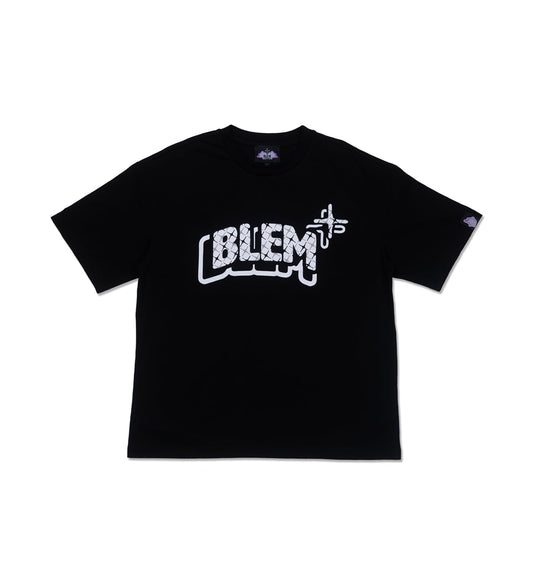
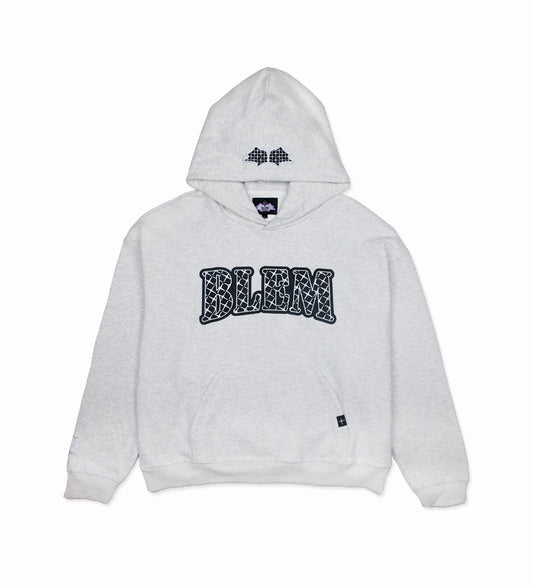
Blem was built inside this same context. Every piece is custom-cut, sewn to exact measurements, with a visual language (the wings, the stars) that's doing more than decorating. The brand runs on the idea that what you wear can be a way of claiming space, not just filling it.
Paul, the brand's founder, isn't describing this scene from the outside. He's inside it. The collaborations with local artists and musicians aren't marketing partnerships. They're the brand doing what it was built to do: show up for the work that's already happening and make sure it doesn't go undocumented.
Blem is a Montreal-based brand built on Haitian-Canadian heritage and the creative culture of this city. More at blem.ca